Soundor is an open-source framework and ecosystem for audio plugins. The framework is released under the MIT License, and we want as many people as possible to build with it, commercially or not. Each of the official projects has its own license, shown below. These guidelines are about something else: the Soundor name and logos, so that people can tell the official project from the many projects built with it.
The logo files
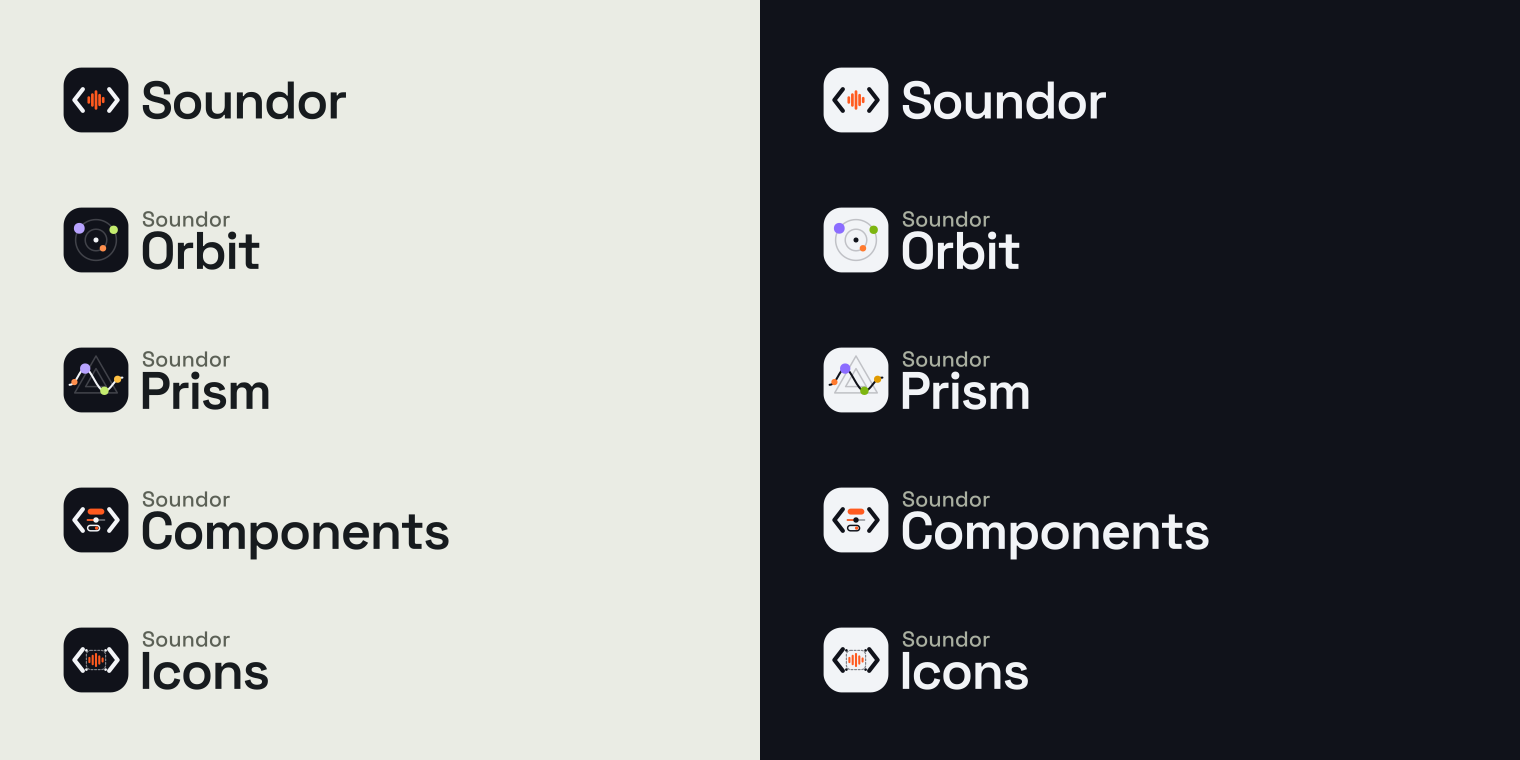
The logos are original artwork, and the copies published with this notice come with their own terms, described in assets/brand/LICENSE.md in each repository. In short, you may use them unmodified to refer to Soundor, as shown below.
Official projects
These are the official Soundor projects. Anything else built with Soundor is independent, which is exactly how it should be.
| Project | What it is | License | Links |
|---|---|---|---|
| Soundor | The framework: CLI, runtimes, engine and libraries | MITThe engine’s dependencies keep their own licenses | Website · GitHub |
| Soundor Components | UI components for Soundor plugins | MIT | Website · GitHub |
| Soundor Icons | Icon collections for Soundor and the browser | MITThe icons keep their upstream licenses | Website · GitHub |
| Soundor Orbit | A three-voice stereo delay plugin | GNU AGPL v3 | Website · GitHub |
| Soundor Prism | A 24-band parametric equalizer plugin | GNU AGPL v3 | Website · GitHub |
The licenses of Soundor Orbit and Soundor Prism cover the plugins, not what is made with them: music and audio you record, mix or render with Orbit or Prism are yours, to release, sell or license as you like.
You are welcome to
- Use Soundor commercially, and build proprietary or open-source plugins with it.
- Modify and distribute each project, under the terms of its license.
- Say that your project is “Built with Soundor”, “Powered by Soundor”, “made with Soundor”, “for Soundor” or “compatible with Soundor”.
- Write about Soundor in documentation, tutorials, articles, courses, talks and videos.
- Use the unmodified logo to link to Soundor or to illustrate something about Soundor itself, such as a review or a tutorial.
Please avoid
- Presenting an independent project as an official Soundor release, for example by naming it “Soundor Reverb” or “Soundor Synth”.
- Implying that Soundor endorses, certifies, sponsors or is affiliated with your project, unless we agreed to it.
- Using the Soundor logos, or a look-alike, as the logo or app icon of your own product.
- Changing the logos (recolouring, distorting, adding to them) in a way that could pass for an official variant.
- Using names, domains, package names or accounts that people could mistake for official Soundor ones.
Naming your project
Give your project its own name and its own logo, and mention Soundor after it:
- Good: “Driftwood, a reverb built with Soundor”, “Acme Synth (powered by Soundor)”, “soundor-midi-tools: MIDI helpers for Soundor”.
- Avoid: “Soundor Driftwood”, “SoundorSynth”, “Official Soundor MIDI Tools”.
If you publish a fork, give it a different name, say that it is based on Soundor, and keep its license and copyright notice, as the license requires.
Using the logos
Use the files as they are: keep their proportions and colours, leave clear space around them (at least half the icon’s height), and use the “on dark” versions on dark backgrounds. The logo reads best between 32 and 64 px tall.
 SVG
Logo
For light backgrounds
 SVG
Logo on dark
For dark backgrounds
 SVG
Icon
For light backgrounds
 SVG
Icon on dark
For dark backgrounds
One-colour and maskable versions, and the social preview images, are in assets/brand on GitHub. Soundor Components, Soundor Icons, Soundor Orbit and Soundor Prism keep their own logos in the same folder of their repositories.
Colours
- Ink
#10121A - Light
#F2F4F7 - Accent orange
#FF5A1F
Questions and permission
Not sure whether something fits, or want to do something these guidelines advise against, such as a partnership or an official integration? Open an issue on GitHub and ask. For privacy matters, see the Privacy Policy.